Thinking Like an Economist
The science of choice and incentives
My first economics professor liked to get spicy.
"If you like to assume that there is something wrong with people, go to sociology or psychology down the hall. In here, we assume there is something right with people."
It was our first lecture, and he was explaining that economists like to assume the best of people: that people are rational. This is the fundamental assumption of economics, and it comes in two parts: people optimize for utility, and people respond to incentives. What is an incentive? A reward or penalty that motivates us to act — the force that tips the scales when we weigh costs against benefits. And what is utility? An economist's measure of satisfaction, well-being, or value: the subjective "good stuff" we get from the choices we make. When we say people are rational, we mean they spend their limited resources — money, a spare kidney, a few free hours — in the way that yields the best possible utility. Rationality doesn't mean people are cold, unfeeling calculators; it means they have goals, face constraints, and optimize — they do the best they can with what they have to reach the outcomes they value most.
Consider one of the greatest choices in all of economics: should we optimize our policies for economic growth, or for helping the poorest among us? Should government focus on redistribution, or should it pursue an economic agenda?
This chapter will help you to think like economists do: to respect peoples' choices, to ignore what they say in favor of what they actually do, and to always, always, always look at the tradeoffs involved in a given choice. We won't answer that question, but we'll make you think about it more deliberately.
And we will begin by using an old idea by Gordon Tullock, an economist from George Mason University: A spike, placed on every steering wheel on every car on every road, to reduce traffic deaths.
The big picture
The First Lesson of Economics is Scarcity
Choice, trade-offs, and opportunity cost
The first lesson of economics is scarcity: there is never enough of anything to satisfy all who want it. The first lesson of politics is to disregard the first lesson of economics.
— Thomas Sowell
You have been elected benevolent dictator. Your first decision: expand programs that improve the lives of people with low incomes today, or adopt policies expected to produce a slightly faster-growing economy. Which do you choose?
It is tempting to say, “both.” Sometimes that is possible, and economists are delighted when it is. But economics begins with scarcity: resources, time, attention, land, labor, and administrative capacity cannot serve every valuable purpose at once. A student chooses between friends and exam prep. A family chooses between spending now and saving. A society chooses between helping visible people now and protecting the productive capacity that will shape lives later.
The Enterprise on Star Trek: The Next Generation had a “replicator” that made food out of ambient particles on request. That looks like the end of scarcity.
But even Captain Picard must choose between Earl Grey tea and Château Picard wine, between the replicator and the holodeck. Technology makes particular goods cheaper. It cannot make time, attention, physical space, or human purpose infinite.
Scarcity is not so easy to circumvent. Even with the magic of science fiction, scarcity is woven into the very fabric of reality.
Misconception“Scarce, rare, and shortage all mean the same thing.”▸
Rare means uncommon. Scarce means using a resource one way prevents using it every other desired way. Shortage means people want more at the current price than is available.
Clean water can be common and still scarce, because water used on one field cannot also be used on another. A store can have a temporary toy shortage without changing the deeper fact that all societies face scarcity.
A trade-off appears when gaining more of one valued thing requires accepting less of another. When a government spends on the military rather than consumer goods, that is the classic “guns versus butter” trade-off. But there are an infinite number of them, because every choice is one: studying or seeing friends; whether to go shopping, and what to buy once you are there; which college to attend, which major to pursue, which classes to take. Each is a fork with a road not taken.
This has particular bite in public policy. As Thomas Sowell put it, “there are no solutions, only trade-offs” — every solution carries a cost. Bryan Caplan pushes the same point somewhere uncomfortable: the socially optimal rate of crime is greater than zero. Why? Because the police state required to stamp out the last of it is not worth what it would cost the rest of us.
The trade-off is not always between an activity and money. A local service station choosing between more diagnostic computers and fewer mechanics, or fewer computers and more mechanics, is trading capital against labor — more technology and less human attention, or the reverse. Every recipe for producing something is a bundle of such trades.
The opportunity cost of a choice is the value of the best alternative given up. It is not necessarily money, regret, or the sum of every rejected option. It is the single best thing you could have done instead. Use a free airline voucher for a weekend trip rather than selling it for $400, and the ticket's cash price is zero — but its opportunity cost includes the $400 you surrendered. “Free” describes the cash you paid, not the value you gave up.
In one hour, Crusoe can catch 3 fish or gather 12 coconuts. He chooses to fish.
- Fishing produces 3 fish.
- The best alternative use of that hour is gathering coconuts.
- In that hour he could have gathered 12 coconuts.
Quick checkA city spends $10 million on a stadium and points to the construction jobs. What does opportunity-cost reasoning require you to ask?▸
Quick checkA bakery can use its counter space for a coffee bar or a pastry case, not both. Name the trade-off and the opportunity cost of choosing coffee.▸
RetrievalIn two sentences, explain why scarcity necessarily creates opportunity cost.▸
Scarcity means a resource cannot satisfy every competing use. Choosing one use therefore sacrifices the value of the best available alternative — and that sacrificed value is the opportunity cost.
The Rationality Assumption
There is something right with you
If economists assume something is right with people, what does that look like in practice?
In advanced economics classes, you will learn about choice models with high levels of specificity. For now, it's enough to understand the rationality assumption in terms of both dignity and modeling: The economist's first response to a puzzling choice is not “what is wrong with this person?” It is “what makes this choice sensible from where the person stands?” That posture treats people as agents rather than objects.
Then, in terms of models: Economists usually begin with a rationality assumption defined as follows:
1. Rational people use available and relevant information to pursue their objectives.
2. Rational people maximize their well-being.
3. Rational people respond to incentives.
4. Rational people think at the margin.
5. Rational people are a good model for real people, even if real people aren't always perfectly rational.
This set of ideas are working assumptions, not a claim that people are flawless calculators. Rational people can lack information, misjudge probabilities, act impulsively, care about others, or pursue goals you dislike. Rationality does not certify that an objective is admirable. It gives behavior enough structure to explain and predict — the point is not to slander people or to bestow sainthood on them, but to understand what they do.
| It claims | It does not claim |
|---|---|
| People pursue purposes. | Every purpose is wise or moral. |
| People use available and relevant information. | People know everything. |
| Choices respond systematically to perceived costs and benefits. | People never make mistakes. |
| Behavior is predictable enough to model. | Every person reacts identically. |
Quick checkWhen economists say someone is rational, does that mean they know everything, always choose perfectly, or they use relevant available information to pursue their objectives?
▸
Quick checkIn economic models, what does each side aim to maximize — and how does Apple's pricing illustrate it?▸
Quick checkWhich is a decision made “at the margin”: quitting your job, attending college, or buying one more soda?▸
Quick checkA factory already runs two shifts and asks whether to add a third. Phrase the marginal question it should answer.▸
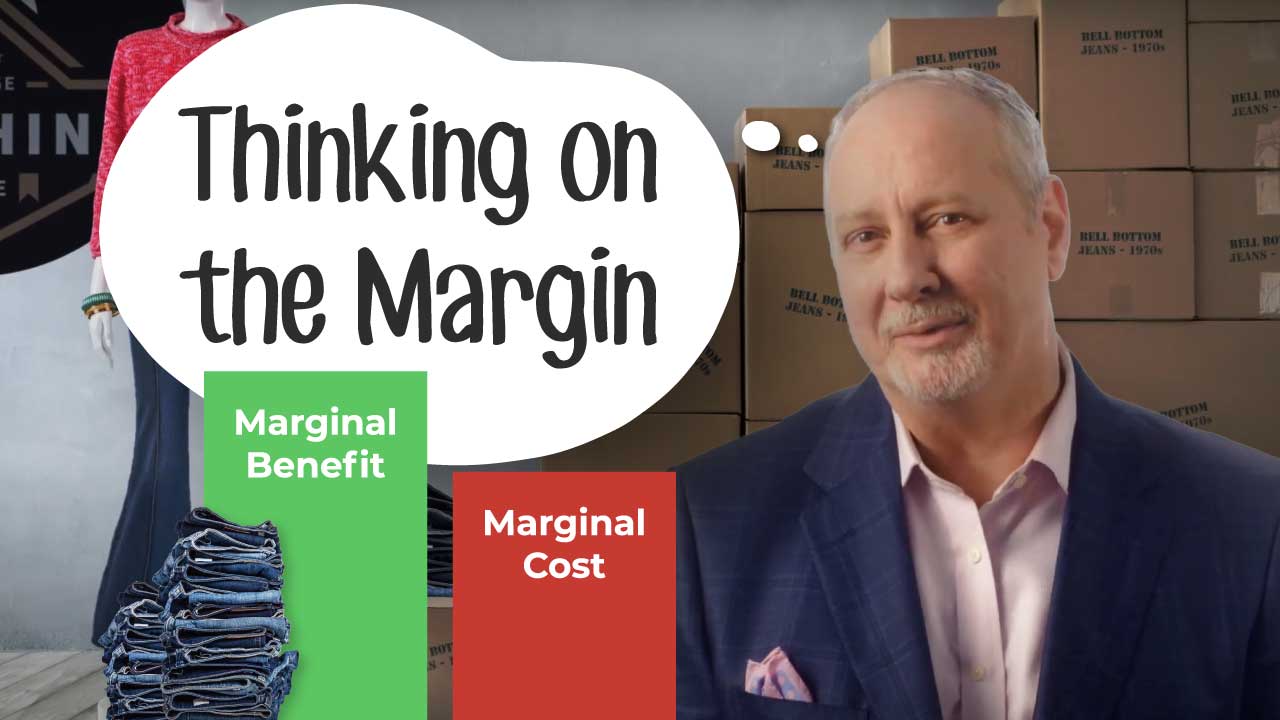
We will cover the marginality assumption in more depth later. For now, you need only understand that rationality implies marginal thinking: you do not choose between all soda and no soda, or between working zero hours and working every hour. You choose whether to do a little more or a little less. If the next unit's benefit exceeds its cost, do it; keep going until the two are equal.
Revealed preferences: talk is cheap
Economists trust that people are doing the best they can with what they have — but we trust their actions far more than their words. Talk, after all, is cheap.
So what people tell you they value can be sincere and still predict their behavior poorly. Ask Americans in a survey whether they care about the environment, or whether they would consider going electric, and large majorities say yes. Then look at what they actually drive off the lot: for nearly fifty years running, the best-selling vehicle in the country has been a full-size pickup — the Ford F-Series — and trucks and SUVs dominate the sales charts while fully electric cars remain a modest slice. What people say and what people buy, with their own money and at real prices, point in different directions. This is the principle of revealed preference: the best evidence on what people value is what they do, not what they say.
Quick checkSurveys show most Americans say they'd like to drive something greener, yet pickups and SUVs top the sales charts. What does revealed preference let you conclude — and what does it not?▸
People respond to incentives
Gordon Tullock once proposed a grotesque thought experiment: mount a steel spike on every steering wheel, aimed straight at the driver's chest, on the theory that people drive exactly as carefully as the stakes make them. Change what a choice costs, and you change what people do.
He was not recommending anyone build the thing. He was making one idea impossible to ignore: people respond to incentives. Make a crash more personally costly, and drivers will probably slow down, leave more room, and pay closer attention.
Imagine your car had a steel spike in the center of the wheel, pointed at your chest. Would you drive more carefully?

While the example is vivid, there may well be some truth in it. It might actually be that such a scheme might save lives. As cars become safer, people drive more. As people drive more, they have more accidents. In the last 50 years, the average deaths-per-accident have dropped significantly, but the annual traffic deaths number has stayed more-or-less flat.
Why? On one theory, because people respond to incentives. People drive more recklessly today precisely because car accidents are so much safer.

Note the following side-by-side graphs, taken from the Congressional Research Service. The first shows the declining rate of deaths-per-accident, the second shows the stubborn rate of deaths
Traffic fatality rate per crash:

Traffic deaths, annual:

The Tullock spike works the same way: it changes the driver's personal consequence of a collision. A fee on disposable bags changes the cost of taking another. A scholarship changes the benefit of earning a grade. When the terms of choice change, some choices change. And because an incentive is just a lever, one principle explains both the good and the bad — the rule that quietly steers people right, and the one that steers them somewhere absurd.
Consider a different example: DNA databases. Police who have access to DNA records can catch bad guys at higher rates. Expanding one makes identification and conviction more likely, which raises the expected cost of committing certain crimes. Incentive reasoning predicts less crime, other things equal — without requiring any offender to become a statistician.
The nail plan that backfired. A famous cartoon in the Soviet satirical magazine Krokodil showed a factory proudly fulfilling its month's plan with a single, crane-sized nail — because the plan was measured in tons. A good rule for business leadership is that you will get more of what you reward: if you want increased tonnage, you will get more tonnage. Reward the sheer number of nails and the same floor buries the country in useless tacks. Note that while this is a joke, it is also a documented event: economist Alec Nove recorded that Soviet goods planned by weight came out absurdly heavy: sheet steel too thick, window glass too heavy, paper too thick. The managers were not fools; they were responding, rationally, to exactly what they were told to maximize. Measure the wrong thing, and rational people hand you the wrong thing.
The doorbell that might deter. Another example is a current, live debate; a cousin to the DNA database. Video doorbells like Ring are meant to raise a burglar's odds of being seen and caught, which lowers the expected payoff of the crime — and surveys find most burglars say they would skip a house showing visible cameras. Sound logic. But does it actually cut crime? At present, the independent evidence is thin and mixed. An MIT Media Lab analysis found no strong sign that video doorbells reduced property crime across Los Angeles; researchers warn that crime may simply shift to the next street; and much of the rosier claim traces back to the company selling the device. We will have to wait to see what comes from research over the next few years for something more determinative.
Quick checkWhy would a larger DNA database be expected to reduce the incentive to commit crime?▸
RetrievalWhy is the rationality assumption useful even though people sometimes act impulsively?▸
A model need not explain every choice perfectly to organize and predict many of them. Purposeful behavior gives a useful baseline; departures from it can then be studied rather than assumed to make behavior random.
Economic Models and Modeling
A model is a lie that tells the truth.
A road map is a masterpiece of leaving things out. No trees, no weather, no traffic, no people — almost the entire world, deleted. And that deletion is the whole point: a map that showed everything would be the size of the city and just as impossible to read. An economic model does the same to a question. It throws away most of reality on purpose, so that one relationship stands out sharply enough to reason about.
Models are a main tool in the economist's kit. A model works like a map: not a true, point-for-point copy of the territory — a map that marked every blade of grass would be useless — but a deliberate, meaningful simplification that helps you get somewhere. As the statistician George Box put it, all models are wrong, but some are useful. The rationality assumption is wrong about plenty of people some of the time; it earns its keep because it is right enough, often enough, to predict how an entire market will move.
The Tullock spike is a model. It is cartoonishly unrealistic — no real car has a dagger in the wheel — and that is fine, because its job is not to be a car. Its job is to isolate one true thing: raise the personal cost of a crash and drivers get careful. So the amateur's complaint, “that's not realistic,” misses every time — every model is unrealistic. The professional asks the sharper question: does the thing you left out change the answer?
Weak: “That assumption is unrealistic.” True of every model ever built — it lands no blow.
Strong: “The feature you dropped is the one that flips the prediction.” That one draws blood.
Building a model means making its moves out loud. You fix the assumptions — the simplified world it runs in (“people pursue purposes under constraints”). You name the variables — the measurable things that can move: price, hours worked, tax rate, the odds of arrest. Then you commit to a hypothesis, a testable claim about how those variables connect, usually a causal one: raise the penalty for an action, get less of it, other things equal.
Notice that the purpose of a model is to test it: a hypothesis has to be able to be wrong. “This policy changes society in mysterious ways” risks nothing and predicts nothing. “A five-cent bag fee cuts disposable-bag use” sticks its neck out: watch the checkout lanes, and reality can prove it false. Question, assumptions, variables, hypothesis, prediction, evidence — then revise and run it again. That loop is the engine of the whole discipline. Economists are fundamentally empiricists: we let reality weigh in on the questions we ask.
Ceteris paribus: hold all things equal
Ceteris paribus — “other things equal” — is how a model pins the world down long enough to watch one thing move. “Ceteris paribus, a higher price lowers the quantity people buy” doesn't claim price is all that matters; it holds tastes, income, and expectations still and watches price alone. You need the move because the world refuses to cooperate: ice-cream sales and sunburns climb together every summer, yet ice cream burns no one — the sun moves both. Without some way to compare like with like, correlation cheerfully impersonates cause.
Sometimes history runs the experiment for you. North and South Korea from orbit — one side black, the other blazing — is so striking because the split held language, ancestry, geography, and culture roughly constant while institutions pulled apart. The image we used in the introduction refers to something called a natural experiment: not a sealed laboratory, but as close as we can come in economics. War, politics, and outside support differed too. But it comes close enough to “other things equal” that the lessons are hard to wave away.
Empiricism: reality gets the final vote
Empiricism is the belief that we should follow the evidence. The rule claims that we should answer to evidence, not to eloquence. A beautiful theory the data contradict is simply wrong, however sincerely it is argued. Perfect evidence almost never exists; the goal is the explanation that survives the hardest honest attempts to kill it — run against experiments, natural experiments, historical comparisons, administrative records, prices, and the choices people actually make.
This is also what a model is for. Point one at tariffs, taxes, crime, pollution, or which occupations will be hiring next decade, and it does the same job every time: force the assumptions into the open, define the variables, and say in advance what result would prove it wrong. The demand-and-supply model we build in later chapters is the workhorse — it explains how buyers' and sellers' choices settle on a price. Disciplined simplification is the strength; a simplification whose deletions are hidden is the danger.
The Circular Flow Diagram: Our First Economic Model
Now it is time for our first model.
The simplest map of an entire economy has just two kinds of players — households and firms — meeting in two kinds of markets.
In the product market, firms sell goods and services and households buy them. In the factor market, the roles flip: households are the sellers, because households own the resources — their labor, their land, their savings — and firms buy those resources to produce.
Follow the money and it runs in a loop. Household spending in the product market becomes firms' revenue; firms pay that revenue back out as wages, rent, interest, and profit in the factor market; that becomes household income, which gets spent again. One person's spending is the next person's income, all the way around — with goods and resources flowing the opposite direction.

Two things are worth seeing. First, just how much this model leaves out. No government, no banks, no trade, no clock. That isn't an oversight; it's the simplification that makes the picture readable. Much of this book is the story of adding those pieces back, one at a time, wherever the clean loop breaks down.
The second thing worth noting is just how much this model tells us about real life. Here are just a few examples:
- One person's cost is another's profit: When you pay money to buy shampoo, your money benefits the firm. When the shampoo factory pays wages, those wages benefit workers. Costs feel like a downside to you, but they're an upside to someone else.
- Interdependence is everything: The economy works because we help each other.
- You are both a consumer and a producer: Milton Friedman once pointed out that you do not want prices to go down. Neither do you want them to go up! You want the prices of the things you buy to go down, and the prices of the things you sell to go up! You are a consumer when you buy products, but you are a producer when you sell your labor. You cannot see only half of the equation!
Quick checkIn the circular-flow model, what is each player assumed to be trying to do?▸
Quick checkIn the factor market, who is the seller — households or firms?▸
Quick checkThe simple circular flow has no government, no banks, and no foreign trade. Is that a flaw?▸
Quick checkWhy must an economic model omit many real-world details?▸
Quick check“Higher expected wages cause more students to enter a major.” Name two variables and say what makes this a hypothesis.▸
Quick checkAre the variables in an economic model measurable or immeasurable? Give two examples.▸
Quick checkWhat separates a genuine hypothesis from a claim like “this policy changes society in mysterious ways”?▸
Quick checkEconomic hypotheses are usually about what kind of relationship between variables?▸
RetrievalWhat did George Box say about models?
▸
George Box said that "All models are wrong, but some are useful."
Seeing the Unseen
How economists see the world
Before you can think like an economist, you must learn to see like an economist.
In 1850, the French economist Frédéric Bastiat told a small story that still ranks among the most useful things an economist can carry. A shopkeeper's son breaks a window. A crowd gathers and consoles him: the accident gives work to the glazier (the glass worker), who will spend the money elsewhere. Perhaps destruction is good for business.
Bastiat's reply is wisdom that the discipline of economics takes very seriously, and it answers our question about WWII as well. The crowd counts the seen — the glazier's new work. It misses the unseen — the suit the shopkeeper would have bought with the same money. Without the broken window he would have owned a window and a suit; afterward he has only a restored window. The glazier's visible gain is matched by the tailor's invisible loss.
The broken-window fallacy is a mistake of not seeing all of the involved variables. In this case, we assume that "repairing windows will help the economy" when it won't: repair doesn't improve well-being. Rebuilding after a hurricane employs people, but the same labor and materials could otherwise have built additional homes, machines, or medicine. This matters most in politics, where visible beneficiaries gather for photographs while opportunity costs scatter across taxpayers, consumers, and future people. A good economist becomes stubborn on their behalf.
There are legion applications of this understanding. Do you want inflation to go up, or to go down? It depends: you likely want your money to have more purchasing power when you purchase, but less purchasing power when you pay others for goods. As a simple rule-of-thumb, then, inflation benefits those with large debts just as it harms lenders; deflation would invert that logic: benefitting lenders and harming debtors. Your thinking on any economic question can be improved simply by insisting on seeing the unseen.
Positive vs. Normative
We're almost ready to apply these tools to one of the most fundamental arguments in economics: income redistribution. Before we do, however, there is one more tool we need to learn to wield carefully before a brief synthesis.
Pull almost any economic question apart — “we should expand food aid,” “that will just make people work less” — and you find two different arguments wearing one coat. One is about what is true; the other is about what is right.
A positive statement describes what is, was, or will be, and can be checked against data: “SNAP raises recipients' food spending”; “a steeper phaseout cuts hours worked.” A normative statement judges what ought to be: “no child should go hungry”; “this help is worth its cost.” “Positive” does not mean favorable and “normative” does not mean irrational — a positive claim can describe a horror and still be false, and a normative claim can be carefully reasoned. The distinction just tells you which kind of argument you are in, and so what could possibly end it: evidence can settle a positive dispute, but only values can settle a normative one. That is why a complete policy argument always needs one of each — a factual premise (the program does this) and a value premise (this is worth it).
Note that economists do both: when the economist is acting as a policy advisor, her role is to talk values, application, and context. When the economist is acting as a scientist, her goal is to talk through prediction, estimation, and causal relationships. The key idea is this: you will be better at both jobs if you take them one at a time. Far too often, an ineffective policy that feels good gets too much attention and resources; and just as often, an effective-but-counterintuitive policy gets nil. While the Tullock spike is an extreme example, it's a manifestation of how economists think precisely because it's coarse and tawdry, and utterly effective.
Thinking Like An Economist
Now that we've described several tools, let's put them in one place and a add a few more to make a more complete synthesis. Seeing the unseen and the normative/positive distinction are core parts of how economists view the world, but aren't the only ones worth a mention. While we're on the topic, here are five major habits of mind that economists adopt — and it's also the posture the rest of this book assumes. The first three are how an economist sees; the last two are how an economist works.
“Wherever people choose, economics follows.”
- People, not money. Economics is a social science about human choice under scarcity, not a business discipline about money. Money is only the ruler we use to measure, but we care about people, flourishing, and well-being as much as we do about stock prices.
- The machinery of behavior — incentives, constraints, information, rules, institutions — if people are making choices, it is squarely in the domain of economics, and deserves a place in this book.
- Study anything. An economist friend once gave me the advice to study economics then specialize in my preferred field: crime, family, education, safety, etc. If people are choosing under constraints, an economist is interested. Being an economist is less about domain of study and more about statistical tools and serious inquiry, plus a set of assumptions like the ones we're discussing here.
“There is something right with you.”
- People are purposeful, optimizing as best they can under constraints — ask how a choice makes sense from where they stand.
- Incentives are the hidden physics of behavior; change the payoff and some choices change.
- Revealed preference: trust what people do, and watch what they sacrifice, more than what they say.
- Err on the side of freedom — people usually know their own lives better than distant observers do.
“There is no such thing as a free lunch.”
- Scarcity forces choice; opportunity cost is the real cost, and the honest question is always “compared to what?”
- No solutions, only trade-offs. Good intentions do not repeal constraints.
- See the unseen — the displaced alternative counts as much as the visible gain.
“In God we trust; all others bring data.”
- Claims answer to evidence. Economists believe fiercely in measuring outcomes by evidence found in real life. It isn't about eloquence or good intentions. It's about what works.
- Compare like with like — ceteris paribus. That's why Korea is a perfect worked example — so correlation cannot impersonate cause.
- Keep is apart from ought; know when you're looking at facts vs. when you're looking at values. And always judge policy by outcomes, not by the warmth of its motives.
“The economist is a contrarian."
- Ask “is that actually true?” even of the comfortable, popular claim.
- Say the finding out loud when the evidence points somewhere the room would rather it did not.
- Disagreeable in inquiry, not temperament because economists can be happy and optimistic while also asking hard questions and maintaining rigorous standards.
Quick checkA hurricane destroys homes and rebuilding raises measured construction activity. Explain the seen effect, the unseen effect, and the broken-window error.▸
Equity vs. Efficiency: The Income Redistribution Debate
Enlarging vs. distributing the pie
Among economists, there is a strong presumption in favor of "enlarging the pie" rather than distributing it. What does that mean, and why does it matter?
In economics, "efficiency" has a multitude of meanings; for now, a simple version would be this: an efficient outcome is one in which the size of the pie is maximized. You will note that there is nothing to suggest that a large pie is going to be split evenly among all at the table, however. Why, then, do economists focus so much on efficiency instead of equity?
One reason is practical: distribution can be difficult to model. It is relatively straightforward to ask whether a policy increases total output, lowers costs, or makes a market more efficient. It is much harder to model exactly who gains, who loses, by how much, and how much those gains and losses matter to each person. So economists often simplify the problem. First ask how large the pie will be; worry later about how it is divided. This is also a careful strategy on the part of economists: not to suggest that distribution doesn't matter, but that by separating the parts of the argument, they can be more effective at each part.
A second reason is philosophical: data cannot tell us what a fair distribution looks like. Economics can estimate that one policy gives Person A $100 while costing Person B $80. But economics cannot tell us whether that trade is morally acceptable. Should we care more about the poor than the rich? How much inequality is too much? How much should property rights constrain redistribution? Those are questions about values. Evidence can inform them, but it cannot settle them. Economists therefore tend to be much more comfortable talking about efficiency than fairness.
There are other reasons we will finish the chapter with, too. For now, however, the purpose of the rest of this chapter is to give you a strong argument for both sides. You may disagree with any such views, of course. Our goal is simply to leave you smarter for having thought through it all.
A Crash Course in the History — and Effectiveness of — Redistribution
Redistribution can happen in a variety of ways, both private and government-mandated. People redistribute privately when they give money, time, or care — a donor may give to charity because increasing the well-being of poorer people is part of what she values. Government redistributes through taxes and spending. A progressive tax takes a larger percentage of income from higher-income groups than from lower-income groups. SNAP provides food benefits to low-income households; Medicaid provides health coverage to eligible groups. These are in-kind redistribution: assistance directed toward particular goods rather than unrestricted cash. The central disagreement is rarely whether any redistribution should exist — families, charities, insurers, and every modern government already do it. It is how much, through which institutions, for which purposes, and with what consequences.
Has contemporary, American redistribution been a success or a failure?
That depends in great measure on how you define "success," but there are still some clean data worth looking at. The first step, however, is to separate the normative and positive.
Some redistribution show signs of genuine success. Social Security helped drive old-age poverty from roughly 35 percent in 1959 to about 10 percent by the 1990s, and researchers attribute most of that fall to the growth in benefits — one of the largest measured poverty reductions in American history. The Earned Income Tax Credit, which pays only people who work, pulled large numbers of single mothers into the workforce and lifted millions of children out of poverty, with little of the work-discouraging effect a steep phaseout usually brings. And childhood access to food stamps, traced through the program's county-by-county rollout in the 1960s and '70s, shows up decades later as better adult health and higher self-sufficiency — the aid paid a return long after it was spent.
But “worked” is not one thing, and the honesty cuts both ways. As many successes as there are, there are failures in the mix as well.
The Welfare Cliff (100%+ Marginal Tax Rates) When benefits vanish abruptly as income rises, working harder can leave a family worse off. If a worker accepts a $1-per-hour raise and immediately loses a $600-per-month childcare voucher or Medicaid eligibility, they face an effective tax rate over 100%. This "cliff" penalizes career advancement and trap families in poverty, making self-sufficiency financially irrational.
Paternalistic Inefficiencies (Deadweight Loss) In-kind aid assumes the government knows what a family needs better than they do, which often backfires. When programs like SNAP cover food but ban basic essentials like diapers, laundry detergent, or toilet paper, desperate families sell $100 of food benefits on informal markets for $50 cash. This paternalism generates massive deadweight loss: taxpayers spend $100, but the recipient gets only $50 of real value.
Block-Grant Diversion (Bureaucratic Siphoning) Giving states broad flexibility over federal welfare money often results in funds never reaching the poor. Under programs like TANF, states have used block grants to plug state budget holes, subsidize college scholarships for middle-class students, or fund pet political projects. In extreme cases, less than 20% of federal welfare dollars reach impoverished families as direct assistance.
So the positive verdict is real but conditional: some redistribution clearly works, some does not, and design is a major difference.
Proposed Normative Approaches
Now, to the normative side: what should we actually do? That depends heavily on your values. Consider just three cases:
A Utilitarian aims to maximize total well-being. Because an extra dollar usually matters more to someone who has very little than to someone who has a great deal, transferring it from rich to poor could increase overall welfare. Note that most economic analyses rely on a foundation of utilitarianism. Taking $1,000 from a wealthy individual causes minimal loss in well-being, but giving that same $1,000 to a struggling family dramatically expands their health, security, and utility. Redistribution is justified up to the point where the total happiness gained by the poor equals the total economic loss caused by shrinking the overall pie.
A Rawlsian follows philosopher John Rawls, who emphasized the need to take care of the poorest. Rawls asked us to imagine a "veil of ignorance," wherein we knew we would be born to a society, but didn't know what station we would occupy. A truly fair society is one that you would design assuming you could be born into it as anyone—rich, poor, disabled, or brilliant—without knowing your position in advance. Self-interest forces you to choose a system that maximizes the well-being of the least advantaged, since that disadvantaged person could easily be you. Under this difference principle, economic inequalities are only justified if they serve to make the worst-off person better off than they would be under absolute equality—meaning robust redistribution isn’t a matter of pity or charity, but the core requirement of justice. From this perspective, redistribution may be justified if it improves the lives of those at the bottom.
A Libertarian emphasizes individual liberty and property rights. Robert Nozick (a libertarian economist) taught that justice depends entirely on how wealth is acquired, not how it is distributed across society. Since individuals own their own bodies, talent, and labor, taxing their earnings to help others is a form of forced labor—coercively taking the proceeds of your time to serve goals you did not choose. If property is acquired through honest labor or voluntary trade, the resulting distribution is inherently just, regardless of inequality. Redistribution violates fundamental self-ownership, turning state welfare into legalized theft. For libertarian, even if someone else would benefit more from the dollar, that does not necessarily justify the government taking it from its owner.
Who is right?
All of them, in a sense. It is good to learn to adopt the various frameworks as occasional lenses that you can put on and take off. The libertarian framework might feel extreme, for example, but the fierce defense of property rights is part of the liberal consensus mentioned in the introduction to this book that has brought so much wealth. The Rawlsian approach may similarly feel absolutist, until you consider just how many people have so little in any given society.
The economist Arthur Okun had a homely way of picturing redistribution: imagine carrying income from the rich to the poor in a bucket — and the bucket leaks. All of our approaches (Rawlsian, Libertarian, Utilitarian) assume zero leakage. But what if you lose 5%? What if you lose 50%? 100%?
Where does the leakage come from? Every redistribution scheme requires someone to run it, and they require a salary. One of the biggest sources of leakage, however, is from incentive effects: because taxes and transfers can dull the incentive to work, save, and invest on both ends.
The poor receive less than the rich give up. That gap is the leak.
The clever part is what the picture forces you to separate. How big the leak is — ten cents on the dollar? fifty? — is a factual question you can measure and argue about with evidence. How much leak you'll tolerate is a question about values: pour anyway when half spills, and you've revealed how much you prize a more equal result over a bigger total. Two people can agree on every number and still disagree, because they weigh the two things differently. That's the whole equality–efficiency tradeoff in one image — and a clean case of keeping the is apart from the ought.
But — and this is the nuance the metaphor can hide — not every bucket leaks, and a few actually fill. The Earned Income Tax Credit is built to reward work: you only get it if you earn, and it grows as you earn more, so it tends to pull people into the workforce rather than out. Some early-childhood and education spending can pay for itself over the long run, as children grow into more productive, higher-earning, more tax-paying adults. Those are the cases where equality and efficiency point the same direction — which is exactly why they tend to draw agreement across a divided room. So the sharpest version of the redistribution debate isn't "equality versus efficiency" every time; it's which bucket, and h
Quick checkHow do Medicaid and SNAP affect income distribution?▸
Quick checkUnder a progressive income tax, how do higher-income households commonly contribute to public redistribution?▸
On Deserts: Who deserves what? Where economics goes quiet
There is one question in this whole area that economics deliberately refuses to answer — and it is the one people most want answered: what share does each person deserve? An economist can measure how income is actually distributed, and can predict how a tax or a benefit would shift it; both are positive questions with checkable answers. But whether a surgeon should out-earn a schoolteacher tenfold, whether the top one percent holds “too much,” whether a just society equalizes incomes or instead rewards effort, risk, and talent — none of that is the unique purview of the economist. Those are questions of desert, philosophy, and fairness; normative to the core. Economists do not answer such questions. This is not a dodge; it is the discipline keeping its hands clean. An economist can say an enormous amount about what a distribution does while admitting, plainly, that whether it is fair is a moral judgment that is not the special province of regressions, statistics, or economic models.
Quick check“How is income actually distributed across households?” Positive or normative?▸
Quick check“Government should make income more equally distributed.” Positive or normative?▸
RetrievalWhy is separating positive from normative claims useful if values still matter?▸
It reveals whether a disagreement is about evidence, causal prediction, or moral judgment. Values remain indispensable, but they should not be disguised as scientific findings — and factual claims should not be shielded from testing by moral urgency.
Winners, Losers, and the Win-Win
Most economic policies create winners and losers. Economists understand this perfectly well. But much of economics deliberately puts the question of distribution to one side.
We've taken an initial stab at why. Now, we finish the job.
One reason merits more discussion.
Economists are sometimes caricatured as being cold utilitarians who only want to focus on economic growth: GDP per capita above all. Rather than emphasize the welfare of the poorest, they are vulcans who do only what their equations tell them. There is truth in these critiques: economists sometimes become too entranced with their own models, ignore the realities of the economic reality facing everyday people, and obsess over efficiency.
But the caricature falls flat for a variety of reasons. One is that there are plenty of economists who really do obsess with inequality. Similarly, no economist I have ever met is obsessed with economic growth for its own sake. The story goes that the economist would choose per capita GDP over any tradeoff: literacy, infant mortality, or self-surveys of satisfaction. My experience has been nearly the opposite: in every single case, economists favor economic growth because it leads to all the other things that we should really care about.
In short, economists focus on making the pie bigger because has historically solved a remarkable number of distributional problems.
Compare countries—or compare the same country across time—and income per person tends to move together with many of the things we ultimately care about. As societies become richer, extreme poverty falls. Literacy rises. Infant and maternal mortality fall. Life expectancy rises. Children stay in school longer. People gain access to cleaner water, better housing, sanitation, medicine, and technology.


Economic growth does not guarantee that everyone benefits equally. It does not make distribution irrelevant. And GDP is certainly not the same thing as human well-being. But the relationship is strong enough to explain the economist’s instinct: before fighting over how to divide the pie, make sure you are not unnecessarily shrinking it.
That is why economists are so often preoccupied with policies that maximize production, trade, innovation, and growth. They know that every policy has winners and losers. But their first question is usually: Does this make the pie bigger? Another way to look at the same problem: the economist is as troubled by inequity as any other person; but the economist has a unique rage reserved for inefficiencies: benefits left on the table. Or, if you will, flushed down the drain.
If the goal is to maximize the well-being of everyone involved, why stop at everyone alive now? Longtermism — a view linked to the effective-altruism movement — takes seriously that future generations count morally too, and that there may be vastly more of them than there are of us.
This is Bastiat's unseen world, write large. Those of us using traditional utilitarian analysis find the numbers involved staggering — and it is not just the innumberability of the potential beneficiaries, but also their voicelessness that weighs upon the policy maker: today's poor at least have a say in the process. A child ten generations out does not.
The compounding math bites particularly hard. Because growth compounds, even a small, permanent bump in the long-run growth rate can leave future societies enormously richer — and spread across many generations, that gain can dwarf what any one-time redistribution does for people today. A 1% increase in GDP might only make people a little better off, but it might make quintillions richer in the future, compared to mere tens of thousands today. On this view redistribution isn't wrong, but a policy that quietly lowers long-run growth should face a heavy presumption against it, because the bill is paid by people who cannot yet vote.
Not everyone takes this view, of course, and the objections are serious. Whether a given policy actually slows growth is a hypothesis requiring serious empirical work to test. Present need is real and immediate; rights don't become negotiable because of a forecast; and predictions a century — let alone a billion years — out carry deep uncertainty. Critics warn, too, that "think of the future" can become a way to wave away visible suffering now.
Take the argument for what it is: not a verdict, but a reason to put a real weight on the scale for the people who will inherit whatever we build.
Return, one last time, to the choice you were handed on the first page as benevolent dictator: help the people in front of you now, or grow the economy that will carry everyone later. You can finally see why it is so hard — and why our politics leans so heavily toward now. Today's claimants are visible: they can be named, counted, met, and moved by. The people who would inherit a richer, healthier, more capable world are the deepest unseen in the whole book — not thousands, not millions, but potentially a staggering number of future lives, voiceless in every election that will shape what they inherit.
Economics will not hand you an answer. But it will give you reasons to think more carefully about your own.
The moves you can now make
Try each before revealing: compute an opportunity cost, find the marginal choice, predict an incentive effect, and classify positive vs. normative.
Type A · Opportunity cost & trade-offs
A university can use an empty building for tutoring labs or lease it to a company for $300,000 a year. It chooses tutoring. Identify the scarce resource, the trade-off, and the opportunity cost.
Show worked solution▸
The building and its use over time are the scarce resource. The trade-off is tutoring space versus lease revenue and the tenant's activity. If leasing is the best forgone alternative, the opportunity cost is its value — including the $300,000 in rent given up. Note the cost is real even though the university writes no check.
Type B · Marginal analysis & incentives
A coffee shop already open 10 hours a day is deciding whether to stay open an 11th. A city then adds a late-night parking fee near the shop. (i) Phrase the marginal question the owner should ask. (ii) Predict how the parking fee changes the answer, and explain the mechanism.
Show worked solution▸
(i) Does the 11th hour bring in more added revenue than its added cost (wages, utilities)? Open the extra hour only if marginal benefit exceeds marginal cost. (ii) The parking fee raises customers' cost of visiting late, lowering expected late-night traffic. That reduces the marginal benefit of the 11th hour, making the owner more likely to stay closed — an incentive changing a choice at the margin. Magnitude is an empirical question.
Type C · Positive vs. normative
Classify each: (a) “The program raises disposable income and slightly reduces hours worked.” (b) “The health gain is worth the lost work and tax revenue.” (c) “Because the program raises food purchases, it should be expanded.”
Show worked solution▸
(a) Positive — each effect can be measured and could be false. (b) Normative — “worth” assigns relative value to competing consequences. (c) A policy conclusion combining a positive premise (raises food purchases) with an implicit value premise (that outcome is worth its costs). Spotting the buried value premise is the skill.
Type D · Model reasoning
A model predicts a steeper benefit phaseout reduces hours worked. Name one assumption, identify the variables, and state evidence that would weaken the model.
Show worked solution▸
Assumption: recipients notice and respond to the changed payoff from extra earnings. Variables: the phaseout rate and hours worked. Weakening evidence: otherwise-similar recipients facing steeper phaseouts do not reduce hours — which would send us back to revise the assumption or the incentive's strength, not defend the theory by eloquence.
Reason like an economist, end to end
A city is weighing a five-cent fee on disposable grocery bags. Supporters point to the jobs created making reusable bags; opponents call the fee an unfair burden on shoppers.
- Identify the opportunity cost a shopper faces when the fee leads her to bring a reusable bag instead of taking a disposable one. (1 pt)
- State the marginal question a shopper answers at the checkout, and predict how the fee changes her behavior. (1 pt)
- Write one positive claim and one normative claim about the fee, and label each. (1 pt)
- Using the seen/unseen distinction, evaluate the supporters' “it creates jobs” argument. (1 pt)
- State the value premise and the factual premise someone would need to conclude “the city should adopt the fee.” (1 pt)
Reveal a full-credit response▸
(a) The opportunity cost is the convenience she gives up — the time and effort of carrying and remembering a reusable bag — which she judged worth more than five cents before the fee existed.
(b) “Is avoiding the five-cent charge (plus keeping the reusable habit) worth the bother of bringing my own bag this trip?” The fee raises the marginal cost of taking a disposable bag, so at the margin she takes fewer.
(c) Positive: “The fee reduces disposable-bag use per customer.” Normative: “The city should discourage disposable bags.” (Positive is testable; normative expresses an ought.)
(d) The jobs making reusable bags are the seen. The unseen is what the same labor, materials, and spending would otherwise have produced. Job creation alone is not a net gain in wealth — it is a broken-window argument unless the environmental benefit outweighs the displaced production.
(e) Factual premise: the fee produces net benefits (less litter/waste) at acceptable cost. Value premise: those benefits are worth the burden the fee places on shoppers. Both are required — evidence alone cannot deliver the “should.”
Reveal the scoring rubric▸
- 1 pt(a) Names a genuine forgone alternative (convenience/time), not the five cents alone.
- 1 pt(b) States a “one more / one fewer” comparison AND predicts fewer disposable bags.
- 1 pt(c) One testable claim and one ought claim, each correctly labeled.
- 1 pt(d) Identifies the unseen (displaced production) as the flaw in “it creates jobs.”
- 1 pt(e) Supplies both a factual premise and a value premise for the conclusion.
Reveal what loses points▸
- ConceptualIn (a), calling the five-cent charge itself the opportunity cost — the cost is the best alternative given up, not the price tag.
- PrecisionIn (b), saying “she stops using bags” (all-or-nothing) instead of a marginal “a little fewer.”
- Exam craftIn (c), giving two positive claims (or two normative) — the point rewards one of each, correctly labeled.
Economic growth is not a spreadsheet abstraction but a moral good: sustained growth in output per person is the most powerful engine humanity has found for lifting people out of poverty — and its gifts reach even the voiceless legions of those who cannot vote.
policy-makers would favor a strong presumption in favor of economic growth, taking seriously the positive impact of a humming economy. Long-run growth in real GDP per person would be taken seriously — because compounding quietly enriches the people who can't yet vote, Bastiat's unseen on an almost unimaginable scale.
- Scarcity forces trade-offs; every choice carries an opportunity cost.
- Change the payoff and some choices change — incentives move behavior.
- How much present help is worth how much future growth?
- How equal should incomes be, and through which institutions?
Before calling something “free,” ask what you gave up to get it — and decide the next unit at the margin, not all-or-nothing.
When a proposal is defended by its visible winners, ask who pays the unseen cost — and whether the claim is positive or normative.